Project Overview
- Building the first Brawl Stars reinforcement learning pipeline (that I know of!), training an agent from scratch to play the mobile game.
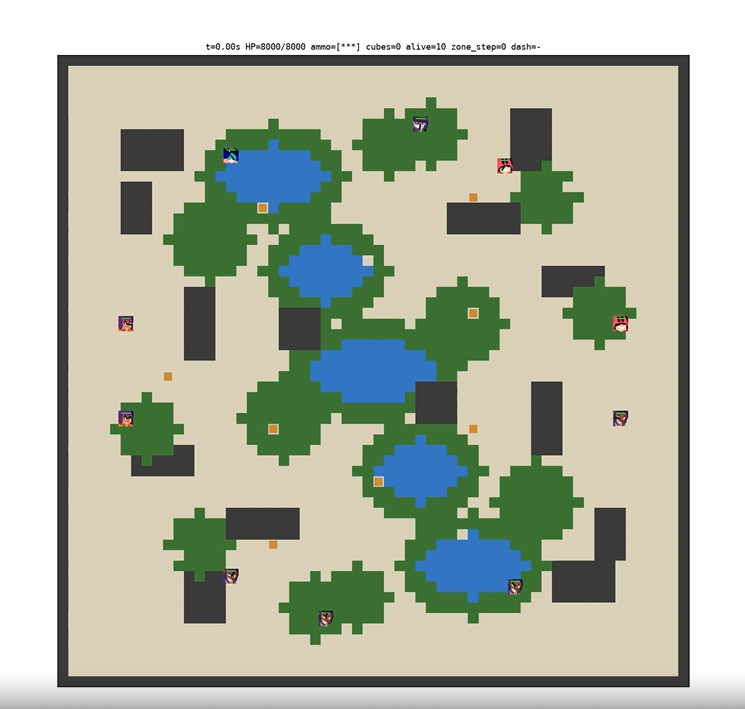
- Trained with PPO in a custom vectorized simulator, running 4,096 parallel environments on a single RTX 5070 Ti.
- Built a computer vision deployment pipeline that translates screenshots of the real game into model inputs using YOLO, OCR, tile classification, and homography-based mapping.
- Documenting each stage of development in a YouTube series, which has passed 500,000 views.
Technologies Used
- Python
- PyTorch
- Stable-Baselines3
- YOLO
- OpenCV
Project Links
Details
This is the first Brawl Stars reinforcement learning pipeline (that I know of!), which I've been developing since July 2026. At its current stage, the bot knows basic movement and fighting mechanics, but I'm really focused on developing skills like using cover, dodging attacks, and managing power-ups. I also decided to document my development process in a YouTube series to keep myself accountable, which has been fun.
The training pipeline involves a custom vectorized simulator of Brawl Stars, where I run 4,096 parallel training environments on my RTX 5070 Ti to train the model via PPO (Proximal Policy Optimization). The model itself is pretty straightforward, just a couple of fully connected MLP layers with some frame stacking. A typical training run is around 450 million games, or 135 billion frames, which usually takes ~16 hours.
The deployment pipeline is a major computer vision project, as I run multiple different systems to translate screenshots of the game into understandable features for my model. The primary component is YOLO to detect projectiles, players, and power-ups. Along with that, I further dissect most YOLO captures with some basic text OCR to extract more features (hitpoints, cooldowns, etc.). I then also run a classifier to label map tiles (walls, bushes, etc.), combined with a perspective homography and odometry to maintain map history.